Coaching in gouda
Do you want to learn to be more effective at handling stress at work?

Coaching to aid in prevention
Coaching can help when your symptoms have not yet become too severe, but are holding you back in your daily life and/or work (for example: when you have perfectionistic tendencies or keep delaying tasks). Coaching can help you to change how you relate to your work and how to handle work-related stress. A coach can help to increase your effectiveness at work so that you do not burn out from work. The coaches at DenkPro in Gouda have extensive experience with a wide variety of complaints and issues. We can help you with your personal problems.
Coaching in Gouda: who are we?
DenkPro is a small psychology practice in Gouda. We do not have a waiting list. Quality of care is a cornerstone of the practice. One of the therapists is English and was raised bilingually (speaking both Dutch and English at a native level) and has extensive experience treating in English and treating expats. Jeroen Rohde started DenkPro. He is GZ-psychologist, coach and cognitive behavioural therapist. Because of his background in public administration, he has specialised in work-related problems. Jeroen Rohde offers coaching at DenkPro in Gouda. Coaching in Gouda (and the surrounding towns, such as Waddinxveen, Boskoop and Woerden) can consist of focus on various issues, which each need their own specific trajectory. For example, we can help you with work-related stress, performance anxiety and procrastination. We also offer online treatments through video calling. We try to cater to your needs as much as possible.
We can offer coaching for
Work-related stress
Assertiveness training
Leadership coaching
Perfectionism and procrastination
Increasing your confidence
Shyness and fear of public speaking
Performance anxiety
Our English-speaking psychologists

Jeroen Rohde
GZ-Psychologist, Cognitive Behavioral Therapist, Public Administration Specialist

Niall Jassim
Clinical psychologist
Why coaching at DenkPro?
A focus on results
We focus on being able to function more effectively in both your work and your private life. Together with you, we will set clear and achievable goals
Cognitive training
We assess which problems hinder you and try to help you understand which thoughts play a role in this. Cognitive training is a type of coaching in Gouda.
Exercises and tools
We will give regular homework assignments, so that you can practice the tools in between the sessions.
Our procedure
01
Registration and intake
In the first session we focus on the problems you are facing. At the end of this session we will discuss what your coaching trajectory will look like in broad lines.
02
Setting clear goals
In the second session we will discuss the goals you want to reach. If you want to involve your employer in a joint conversation, we will only do so with your explicit consent and with clear agreements about what information can be shared. We will review your goals regularly during coaching. Often the sessions start on a weekly basis, but can go to every other week to give you more time to practice the tools in between the sessions.
03
Changing how you relate to your thoughts
We explore how thoughts and patterns affect your feelings and behaviour. Cognitive behavioural therapy (CBT) can help you examine unhelpful beliefs and try out different ways of responding. Sometimes, however, trying to analyse or change every thought can keep you caught in overthinking. Acceptance and Commitment Therapy (ACT) helps you notice thoughts, take a step back and let them come and go without automatically following them. The aim is not to stop thinking, but to become less caught up in your thoughts and make more room for actions that matter to you. We tailor this approach to your needs, including practical changes in your daily life and work.
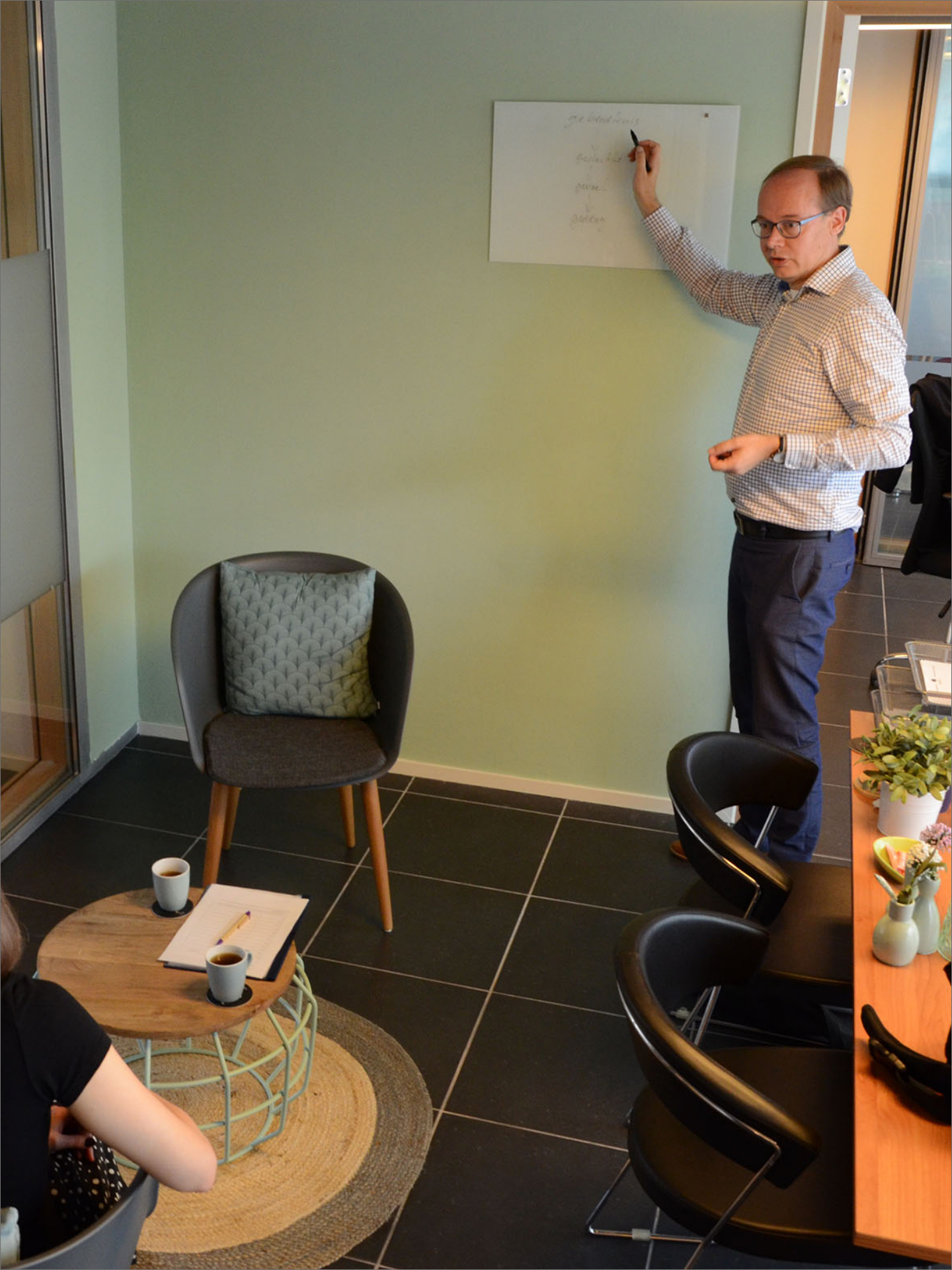
Example of coaching/therapy
A lady reached out to us for help. She is 32 years old and moved to the Netherlands 5 years ago for her work. She met her husband here and has a daughter, but has a limited social life outside this. She said that she felt lonely and that her life focussed only on taking care of her daughter and working. She added that she struggled to expand her social life. She did speak to her parents and sister regularly, but over the phone wasn’t the same and being near them. She also mentioned feeling more and more pressure at work, to the point that she was considering taking sick-leave. Her work came with a lot of responsibility and she was used to working long hours. She got a lot of trust from her peers and managers, but felt like she couldn’t live up to their expectations anymore.
During the intake we assessed her complaints, which seemed to be rooted in two different areas: 1. struggling to adjust to her new life in the Netherlands (i.e. missing her country of origin, trouble finding social contacts, not having any hobbies), 2. putting pressure on herself at work to perform as she had always done. This was the first time she was in treatment, so we decided to focus on the second issue first: putting pressure on herself.
We used cognitive-behavioural therapy to focus on this. She learned to identify certain beliefs that reinforced the pressure she put on herself. Examples of these beliefs are: “If I say no, my boss will not trust me anymore”, “I have to keep going, or else the project will fail” and “I’m a failure”. We first used various techniques to try to undermine these beliefs and put more helpful thoughts in their place (e.g.: “My boss may be surprised if I say no, but will support me setting boundaries sometimes”, “I have to take breaks, or else I will fall ill and can’t help my colleagues at all anymore” and “I have always believed I am a failure, but I have done enough in my life to prove this is not true”). Once these thoughts became easier to believe, we focussed on behaviour which would reinforce them.
She learned techniques to set boundaries in an assertive but kind way. She also agreed to take regular breaks. Once she managed to do this herself, it was agreed that she would continue to work on this herself and that the therapy would focus on her trouble adjusting to her new life in the Netherlands. We spoke about cultural differences and how to bridge these. We looked at areas in her life where she felt comfortable taking a step. Over time, she started taking more and more steps until she felt more comfortable in the Netherlands. She still missed her family, and agreed with her work to have regular holidays to travel back to see them.
Want to know more?
Looking for support for an employee? Explore our English-speaking employee support for companies in Gouda, Rotterdam and The Hague.